Multi Award Winning CPD Accredited Provider
CONNEXIONS
LEGO® Based Therapy Program
Building connection, confidence and meaningful relationships through collaborative LEGO® play.
Connexions is Progressive Play®’s LEGO® Based Therapy program for children and young people.
LEGO® Based Therapy is an evidence-informed, neuro-affirming and strengths-based approach that uses collaborative LEGO® play to create meaningful opportunities for children to communicate, cooperate, problem-solve and connect with others.
At Progressive Play®, our approach is child-centred and responsive to the individual children participating. We recognise that there is no single “right” way to communicate, interact or connect with others. Instead, Connexions provides a supportive environment where children can contribute their ideas, build alongside their peers and develop relationships through a shared interest in LEGO® play.
What is LEGO® Based Therapy?
LEGO® Based Therapy was developed by clinical neuropsychologist Dr Daniel LeGoff in the mid-1990s, following his observation that a shared interest in LEGO® building could naturally bring children together and create opportunities for social interaction and collaboration.
The approach was initially developed through work with autistic children, and much of the research into LEGO® Based Therapy has focused on autistic children and social communication. Over time, the methodology has also been applied more broadly with children and young people with a range of communication, social, emotional and developmental support needs.
Rather than practising social skills in isolation, LEGO® Based Therapy provides children with a shared purpose. They have something tangible to build, discuss, negotiate and solve together.
The LEGO® model is important - but so is everything happening around the build: sharing ideas, asking questions, clarifying information, negotiating decisions, managing different perspectives, solving problems and experiencing the enjoyment of creating something together.
How Does LEGO® Based Therapy Work?
A foundational element of LEGO® Based Therapy is the use of three collaborative roles. Each participant has a distinct responsibility within the building process, creating natural opportunities for communication, cooperation, problem-solving and shared decision-making.
Children rotate through the roles so that everyone has opportunities to experience different responsibilities within the group.
the roles

The Engineer has access to the building instructions and communicates the information needed to complete the model.
They need to describe what they can see clearly enough for the other members of the group to understand what is required.
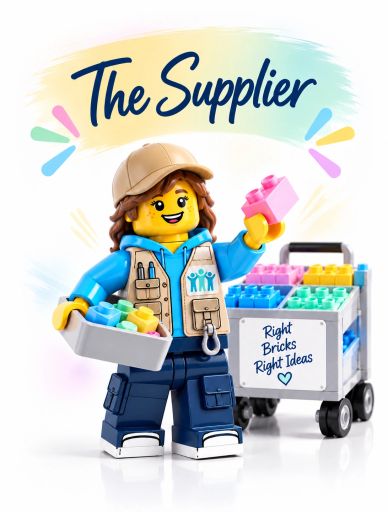
The Supplier identifies and provides the pieces needed for the build.
This involves listening carefully, locating the correct pieces, checking information and communicating with the Engineer and Builder when clarification is needed.
The Builder constructs the model using the pieces supplied and the information communicated by the Engineer.
The Builder may need to ask questions, seek clarification and work collaboratively with the other group members when something doesn’t make sense.
More Than Following Instructions
Although the Engineer, Supplier and Builder roles are foundational to LEGO® Based Therapy, collaborative LEGO® building does not always need to mean recreating a commercial LEGO® model from an instruction booklet.
As children become familiar with the process, they may work together to develop their own models, solve collaborative building challenges, create designs or even develop their own instructions while continuing to use clearly defined collaborative roles.
Connexions sessions may also include opportunities for creative building, individual construction, paired activities and less structured collaborative play.
Structured and unstructured play do not need to compete with one another. They offer different opportunities.
Structure can provide predictability, clearly defined roles and a shared goal, while more open-ended building can support creativity, autonomy, imagination and the exploration of shared interests.
Our facilitators consider the children participating, the dynamics of the group and the purpose of an activity when determining the appropriate level of structure.
Why LEGO®?
LEGO® building provides a highly visual, hands-on and engaging shared activity.
For children who already enjoy LEGO® play, their interest can become a natural point of connection with other children.
Instead of placing the entire focus on conversation or social interaction, children can communicate through and around the activity. There is something concrete in front of them to build, describe, organise, negotiate and change.
The building process can naturally create opportunities for children to practise skills such as communication, planning, sequencing, problem-solving, collaboration and flexible thinking.
Most importantly, LEGO® brick play provides a shared experience around which relationships can develop.
Neuro-Affirming Approach
At Progressive Play®, LEGO® Based Therapy is not used to teach children to appear more neurotypical or to suggest that there is one correct way to socialise.
Our approach is neuro-affirming, strengths-based and child-centred.
We recognise that children communicate, play, regulate, connect and participate in different ways. The goal is not to remove those differences.
Instead, we aim to create an environment where children feel safe to participate authentically while developing skills that are meaningful and useful to them.
This may include learning how to communicate their own ideas and needs, understand the perspectives of others, navigate disagreements, advocate for themselves, solve problems collaboratively and develop connections with peers.
What Can LEGO® Based Therapy Support?
Research into LEGO® Based Therapy has particularly explored outcomes relating to social interaction and communication, predominantly with autistic children.
Within an appropriately facilitated group, LEGO® Based Therapy can provide opportunities to develop and practise areas such as:
Communication and clarification
Collaborative problem-solving
Sharing and communicating ideas
Teamwork and cooperation
Negotiation and shared decision-making
Planning and sequencing
Flexible thinking
Sustained shared engagement
Asking for help
Resolving communication breakdowns
Recognising different perspectives
Confidence within a group
Self-advocacy
Friendship and peer connection
LEGO® building can also involve visual-spatial processing, fine motor skills, memory, descriptive and positional language, planning and organisation.
Every child is different, and participation in LEGO® Based Therapy will not produce identical outcomes for every child. Goals and expectations should always reflect the individual child.
The Connexions Program
Progressive Play®’s Connexions Program brings LEGO® Based Therapy into a small, supportive and professionally facilitated group environment.
Children generally participate in groups of approximately 3–4, allowing each child meaningful opportunities to contribute to the building process and interact with their peers.
Sessions incorporate structured LEGO® Based Therapy alongside other collaborative and creative building experiences, allowing the facilitator to respond to the interests, strengths and needs of the children within each group.
Children are encouraged to bring their own ideas, creativity and personality to the experience.
There is no expectation that children mask who they are or perform a particular style of social interaction in order to participate successfully.
Who is Connexions for?
Connexions is available for children and young people aged 5–17 years who may benefit from additional opportunities for:
Peer connection and friendship
Communication and collaboration
Confidence within group environments
Shared problem-solving
Flexible thinking
Navigating different ideas and perspectives
Participation and belonging.
Children do not require a formal diagnosis to participate.
Group placement is not determined by age alone. We also consider developmental stage, communication preferences, interests, individual support needs and group dynamics when considering an appropriate group.
Who Can Facilitate LEGO® Based Therapy?
LEGO® Based Therapy is used across education, allied health, mental health, disability and community settings.
Appropriately trained facilitators may include teachers and educators, occupational therapists, speech pathologists, psychologists, counsellors, social workers, nurses, support workers, allied health assistants and other professionals working with children and young people.
Parents and carers may also use principles and strategies from the approach within everyday environments.
How LEGO® Based Therapy is implemented should be appropriate to the facilitator’s role, responsibilities and professional scope of practice.
Who Facilitates Our Connexions Groups?
Progressive Play® Connexions groups are facilitated by an appropriately qualified health professional who is also a Certified LEGO® Based Therapy Facilitator.
Our small-group format enables the facilitator to observe and respond to group dynamics while adapting activities to support meaningful participation by the individual children within the group.
The emphasis is not on completing the “perfect” LEGO® model.
The process of building together is where the learning, communication and connection happen.
Join a Connexions Group
Our no-cost 10-week Connexions Program operates during Queensland school terms, with separate age-based groups.
5–7 years
8–10 years
11–13 years
Places are limited to maintain our small-group format.
If you would like to enquire about current availability or discuss whether Connexions may be suitable for your child, please contact Progressive Play® using the button below.
Looking for a LEGO® Based Therapy Facilitator?
Interested in LEGO® Based Therapy Training?
Progressive Play® provides comprehensive online LEGO® Based Therapy Facilitator Certification for professionals working across education, health, allied health, mental health, disability and related settings.
Visit our Education & Training section for further information.
The LEGO® logo, SERIOUS PLAY®, Imaginopedia™, the Minifigure and the Brick and Knob configurations are trademarks of the LEGO® Group, which does not sponsor, authorise, or endorse this website.
Copyright © 2021 - 2026 Progressive Play® - All Rights Reserved.